Biceps and Triceps Machines
Showing all 3 results
Showing all 3 results
Our biceps and triceps machines will help you achieve solid, perfectly toned arm muscles, so you can flex your arms with confidence, anytime, anywhere. These competitively priced yet high-quality machines have a compact footprint, perfect for home and commercial gyms with space limitations.
A bicep curl machine — also called a biceps arm curl machine or seated bicep curl machine — uses a guided arc of motion to isolate the biceps brachii and brachialis. Unlike free weights, the machine keeps tension on the muscle through the full range of motion, which means more time under tension and better hypertrophy stimulus.
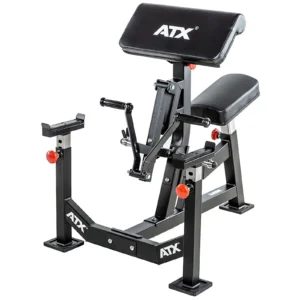
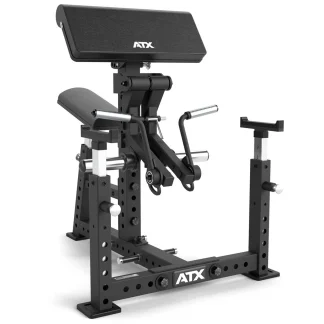
The gold standard for bicep machine training is the bicep preacher curl machine. The angled pad eliminates shoulder involvement and keeps the elbow fixed, making it near-impossible to cheat the rep. It’s the reason preacher curls are a staple in every serious arm day — and why the ATX® Bicep Blaster Preacher Curl Machine is one of the best-selling arm machines we carry.
Your triceps make up two-thirds of your upper arm. If you’re not training them with a dedicated machine, you’re leaving size on the table.
A tricep extension machine typically works the long, lateral, and medial heads of the tricep through either an overhead extension or a pushdown movement. The tricep pushdown machine (or tricep press machine) is the most common — you push a bar or rope attachment downward against a cable stack, keeping elbows tucked and squeezing at the bottom.
The tricep dip machine takes a different approach: it mimics the bodyweight dip pattern with an assisted or weighted mechanism, making it ideal for building mass in the lateral head.
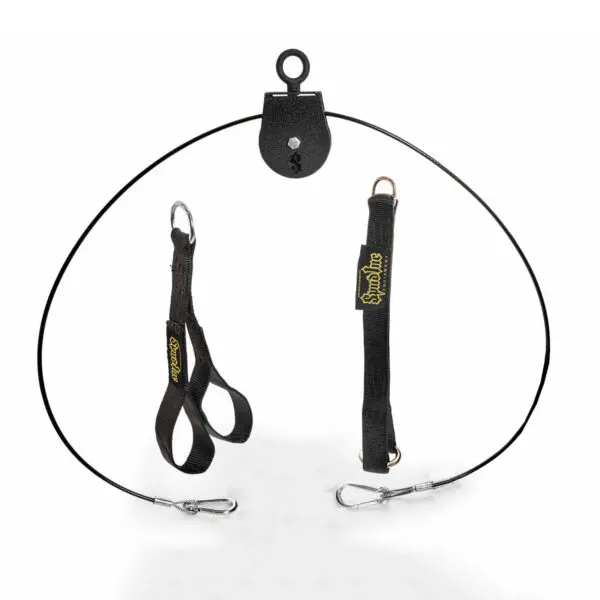
For home gyms, a quality cable pulley system handles tricep pushdowns, overhead extensions, and rope pushdowns — covering every variation you’d find in a commercial gym.
Pairing bicep and tricep machine training in the same session is one of the most efficient ways to train arms. Because biceps and triceps are antagonistic muscles, training them together allows one muscle group to rest while the other works — meaning shorter rest periods, more volume in less time, and a brutal pump.
A typical bicep and tricep machine workout might look like: preacher curls superset with tricep pushdowns, seated curl machine superset with overhead tricep extension, cable curls superset with rope tricep pushdowns.
Both environments can accommodate dedicated arm machines. For home gyms, a preacher curl station and a cable pulley system covers 90% of what you need. For commercial gyms or serious home setups, a standalone tricep extension machine and bicep curl machine round out a complete arm station.
Sam’s Fitness stocks gym machines for biceps and triceps that work in both settings — compact footprint, commercial build quality, no compromise.
 What is a bicep curl machine?
A bicep curl machine is a piece of gym equipment designed to isolate the biceps brachii through a guided arc of motion. The user sits or stands, places their arms on a pad or support, and curls the weight upward. The machine eliminates momentum and keeps tension on the bicep throughout the full range of motion. Common variations include the seated bicep curl machine, preacher curl machine, and arm curl machine.
What is the best machine for training biceps?
The preacher curl machine is widely considered the best machine for isolating the biceps. The angled pad locks the upper arm in place and eliminates shoulder involvement, forcing the bicep to do all the work through a full range of motion. Cable machines are also highly effective, as they maintain constant tension on the bicep regardless of the joint angle — something a fixed machine can’t replicate.
What does a tricep extension machine work?
A tricep extension machine targets all three heads of the tricep: the long head, lateral head, and medial head. Depending on the movement pattern — overhead extension or pushdown — different heads are emphasised. Overhead tricep extension machines hit the long head most effectively, while pushdown machines (tricep press machines) load the lateral and medial heads. Because the triceps make up roughly two-thirds of the upper arm, training them with a dedicated machine produces significant gains in arm size.
Are bicep curl machines effective?
Yes — bicep curl machines are highly effective for hypertrophy, particularly for beginners and intermediate lifters who struggle to achieve full bicep isolation with free weights. The guided movement pattern removes momentum from the equation and forces the bicep to work through the entire arc. For advanced lifters, machines are best used as a complement to barbell and dumbbell curl variations.
Can you train biceps and triceps in the same session?
Yes — training biceps and triceps together in the same session is a proven and efficient approach. Because they are antagonistic muscles, one relaxes while the other contracts, which allows shorter rest periods and more total volume within the session. Supersets — pairing a bicep exercise directly with a tricep exercise — are particularly effective for building arm mass and creating a significant pump.