 Bench Press and Elbow Pain: What You Need to Know
The bench press is one of the best upper body exercises going. It builds serious chest, shoulder and tricep strength, and there’s a reason it’s the centerpiece of most home gym setups. But it’s also one of the most common culprits behind nagging elbow pain — and that pain can creep into everyday life fast.
One day you’re pressing with confidence. The next, you can’t grip a coffee mug without wincing. Depending on severity, bench press elbow pain can resolve on its own within a few weeks, or it can linger for months if you ignore it. In some cases, ongoing irritation leads to chronic conditions like arthritis.
The good news? Corrective exercises and form adjustments can help reduce — and often eliminate — elbow pain from bench pressing. You don’t have to give up the bench. You just need to press smarter.
This article covers the anatomy behind the pain, what causes it, how severe it might be, and practical steps to get back to pain-free pressing.
What Causes Elbow Pain From Bench Pressing?
Elbow pain during the bench press typically comes from one of three sources: overuse, traumatic injury, or an underlying condition. More often than not, it’s overuse.
Overuse and Repetitive Strain
This is the most common cause by a wide margin. Repeated pressing movements — particularly at high volume or high intensity — place cumulative stress on the tendons around the elbow. When the load exceeds what these tendons can recover from between sessions, irritation sets in.
That irritation often shows up as tendinopathy: a breakdown of the tendon tissue that goes beyond simple inflammation. It can be painful to grip a barbell, twist your forearm, or even open a door.
Simple recovery steps for overuse-related elbow pain include easing off pressing volume temporarily, applying a cold compress for 15 minutes several times a day, getting soft tissue work on the forearm, and giving the joint adequate rest between training sessions.
Traumatic Injury
Less common, but worth knowing about. If you’re doing explosive reps and hear a popping noise followed by sudden, sharp pain, you may have a ruptured tendon or a dislocated elbow. This requires immediate medical attention — stop training and see a doctor.
Underlying Conditions
In some cases, elbow pain is a symptom of something that was already brewing. Conditions that can contribute include inflammation of the bursa (bursitis), osteoarthritis and cartilage degeneration, nerve compression on the radial nerve, ligament sprains or tears, and osteochondritis dissecans (loose cartilage and bone fragments in the joint).
If pain persists despite rest and form corrections, these conditions are worth ruling out with a medical professional.
In some cases, elbow pain is a symptom of something that was already brewing. Conditions that can contribute include inflammation of the bursa (bursitis), osteoarthritis and cartilage degeneration, nerve compression on the radial nerve, ligament sprains or tears, and osteochondritis dissecans (loose cartilage and bone fragments in the joint).
If pain persists despite rest and form corrections, these conditions are worth ruling out with a medical professional.
The Recovery Trap to Avoid
During recovery, you still need to keep the elbow moving. About 30 minutes of low-impact aerobic exercise daily is a solid guideline. Complete rest can cause surrounding muscles to weaken and the joint to stiffen, which may lead to further complications like chronic stiffness, infection risk, or accelerated arthritis.
Symptoms of an Elbow Injury
Pain is the obvious one, but it’s not always the only sign. Watch for redness or visible swelling around the joint, a noticeably weaker grip, tenderness when touching the affected area, stiffness or restricted movement in the elbow, and difficulty gripping, holding or carrying objects.
More serious signs of overuse injury include visible deformity, muscle wasting, or asymmetry in the joint. If any of these are present, consult a physician for a proper diagnosis.
How Severe Is Your Elbow Pain?
Not all elbow pain is equal. Understanding where yours sits on the severity scale helps determine the right response.
Mild — Minor discomfort that fades after warming up. Usually a sign of early-stage irritation. Manageable with warm-up adjustments and minor volume tweaks. Keep training, but monitor closely.
Moderate — Pain in the forearm or inner elbow during and after pressing. This can interfere with daily activities. It’s a sign to back off intensity, reduce pressing frequency, and prioritise recovery. If it’s disrupting your day-to-day, see a physiotherapist to prevent things from getting worse.
Severe — Persistent pain that worsens with any physical activity. This may indicate chronic tendinopathy, a tendon rupture, a fracture, or a dislocated joint. Severe cases can affect simple tasks like opening a jar or slicing vegetables. Get to a medical professional as soon as possible.
If mild to moderate pain is caught early, preventive measures and form corrections can often stop it from escalating.
How to Reduce and Prevent Bench Press Elbow Pain
The elbow is a hinge joint under constant stress — it’s one of the most active joints in the body. Some degree of risk comes with any pressing movement, but these strategies can significantly lower that risk and help you manage existing pain.
Warm Up Properly Every Session
This is non-negotiable. A proper warm-up increases blood flow to the muscles and tendons around the elbow, prepping them for the load ahead. Include dynamic stretches and light pressing movements before working sets. Always cool down afterward with light stretching or foam rolling.
Fix Your Bench Press Form
Poor form is one of the leading causes of bench press elbow pain — and it’s entirely fixable.
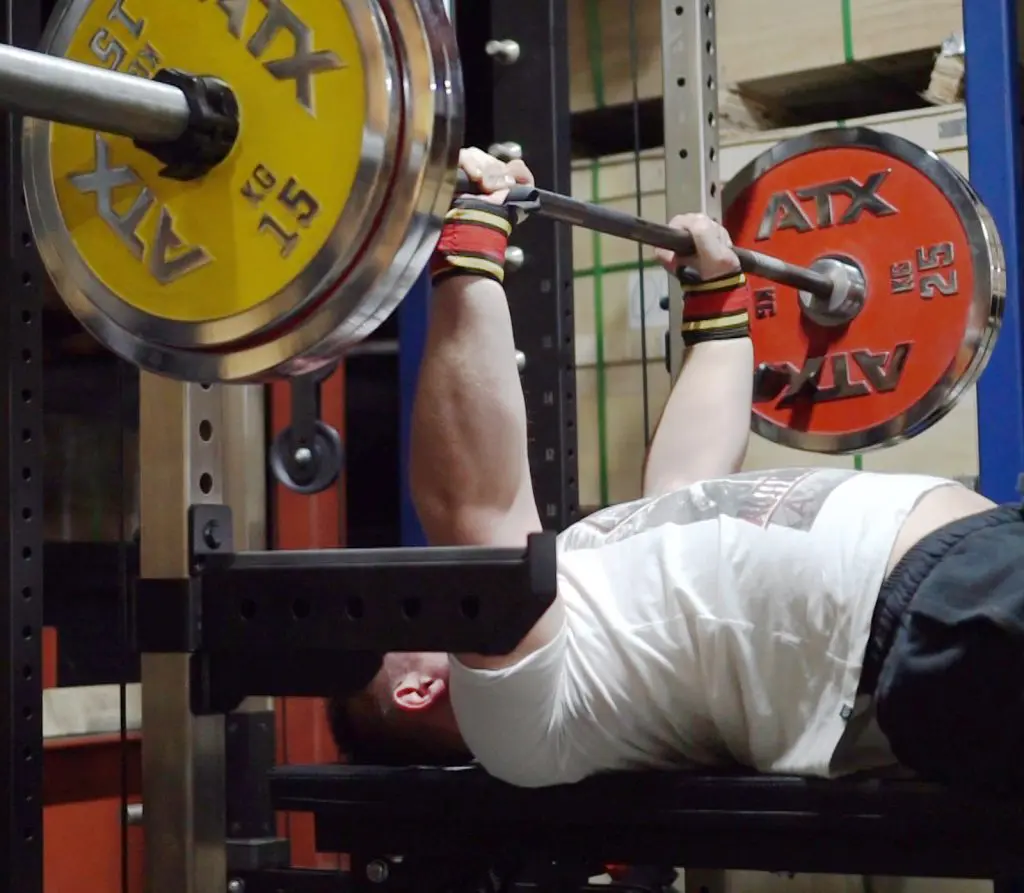
The most common form error is “over-tucking”: bringing the elbows too close to your sides or flaring them too wide. Both positions place the elbow in a mechanically disadvantaged angle, increasing tendon stress.
Correct form checklist:
- Grip the bar at a medium width — roughly 1.5 times shoulder width
- Keep your elbows flared at about 45 degrees to your torso
- Stack your wrists directly over your elbows throughout the movement
- Think about “spreading the bar apart” to engage your lats and reduce elbow load
- Touch the bar low on your chest, not high near your collarbone
If proper form feels awkward, shoulder mobility may be the limiting factor. Two sets of 10 reps each of thoracic extensions and shoulder dislocates (with a band or dowel) twice a week can make a noticeable difference. If you’re still not sure if your form is correct check out How to Bench Press 101
Manage Your Training Load
If pain shows up even at rest, you’ve been pushing too hard. Consider removing a few plates and examining your elbow after each set. If pain persists, reduce weight further.
Reducing bench press frequency also helps. If you’re pressing three times a week, drop to twice. If twice, drop to once. Give your tendons enough recovery time between sessions — rest doesn’t mean doing nothing; it means avoiding the specific aggravating movement.
Substitute Temporarily — Don’t Quit Chest Training
Elbow pain doesn’t mean you need to abandon chest work entirely. Allowing the elbow to heal from pressing doesn’t have to mean losing upper body strength. Swap in accessory exercises that load the chest without as much elbow stress.
Good temporary substitutes include cable exercises (crossovers, chest flys), dumbbell flys (which allow a more natural arm path), machine-based chest press variations, and resistance band pressing.
These movements are generally easier on the elbow because they allow freer wrist and forearm rotation compared to a fixed barbell path.
Try Progressive Tendon Loading
If the issue is tendinopathy, complete rest often makes things worse in the long run. Instead, gradually loading the affected tendons — using exercises that produce only mild discomfort (a 1–2 out of 10 on a pain scale) — stimulates tissue repair and builds tendon resilience.
Good rehab exercises include band tricep push-downs, wrist curls and reverse wrist curls with a light dumbbell, and tempo bench pressing (3 seconds down, 3 seconds up) at a significantly reduced weight.
Progress gradually. The goal is to expose the tendon to controlled stress, not to push through pain.
Consider Physiotherapy
If pain continues after making the above adjustments, a physiotherapist can identify the specific source of pain, assess whether your form and shoulder mechanics are contributing factors, and design a targeted rehab program for your situation.
This is especially important for chronic or recurring elbow pain that hasn’t responded to self-management.
Frequently Asked Questions
The most common reason is overuse — specifically, tendinopathy of the forearm or triceps tendons caused by high training volume, excessive load, or poor pressing mechanics. Adjusting your form, reducing volume, and incorporating rehab exercises usually resolves it.
It depends on severity. Mild discomfort that fades with a warm-up is generally safe to train through with form corrections. Moderate to severe pain — especially pain that affects daily tasks — means you should substitute other chest exercises and focus on recovery.
With proper rehab (form correction, load management and targeted exercises), most cases improve within 2–3 months. Without treatment, tendinopathy can take 6–8 months or longer to resolve on its own.
Elbow sleeves provide compression and warmth, which can help manage mild pain and support recovery. They’re not a fix for the underlying issue, but they can be a useful tool alongside proper form and programming adjustments.
Tennis elbow (lateral epicondylitis) affects the outer elbow and is common when the wrist extensors are overloaded — often from excessive shoulder internal rotation during pressing. Lifter’s elbow (medial epicondylitis) affects the inner elbow and is linked to overloaded wrist flexors. Both are overuse injuries, and both respond well to form correction and progressive tendon loading.
This content is for informational and educational purposes only and does not constitute medical advice. Always consult with a qualified healthcare professional or physiotherapist before starting a new exercise program or if you are experiencing persistent pain.